Confidently Facilitate Meetings.
Your facilitation GPS for meeting success.
Four key frameworks that transform hesitant facilitators into confident meeting leaders — in English, at any fluency level.
4 frameworks that make any meeting manageable.
Each framework covers a distinct phase of meeting facilitation. Together, they form a complete GPS for any meeting situation you'll encounter.
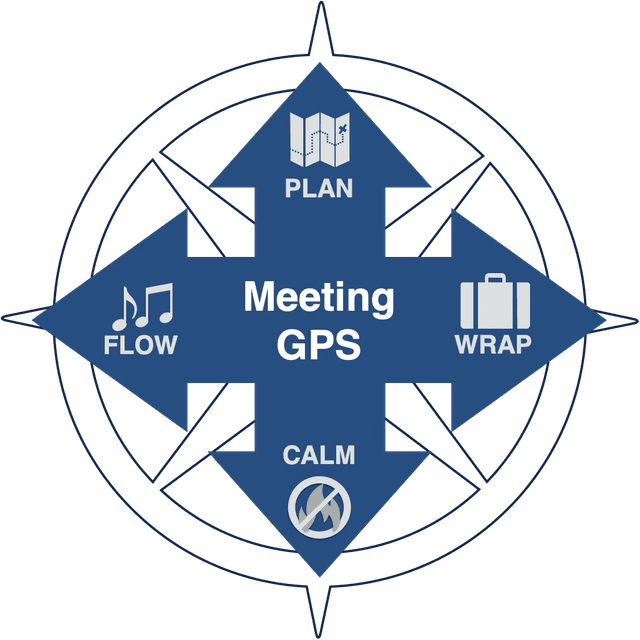
A travel map showing the route before you start.
Like conducting an orchestra: guiding each section at the right time.
Like packing a suitcase: arranging key items neatly for next time.
Like a fire extinguisher: cooling heated situations and restoring harmony.
Succeed with the English you already have.
Unlike traditional programs that make you wait until your English improves, Meeting GPS gives you practical techniques that work immediately with the language skills you already have.

Yumi's Transformation
When Yumi was asked to lead her first global team meeting, she felt uncertain despite her comfortable command of English. She struggled with structuring discussions, managing time effectively, and handling different communication styles from team members across regions.
After the workshop, Yumi used PLAN to set clear goals and prepare for potential challenges. She made CALM part of her regular facilitation style — not just a crisis tool — acknowledging team members' expertise and listening carefully to those who rarely spoke up.
This created a supportive atmosphere where diverse perspectives were naturally included.
"Yumi is a stronger leader now, more confident. She's able to include everyone while still achieving results."
"Before, meetings felt overwhelming. Now, the Meeting GPS is my safety net — I feel confident that everyone is comfortable voicing their opinions, even challenging ones."

The Skill Spy Advantage
Our Skill Spy active observation methodology helps your learning continue long after the workshop — at zero additional cost or time investment.
In their own words.
"That the problem we have now is not a language problem but a communication problem. I am convinced."
"The technique "Stop & Ask": In Japan, it is polite to refrain from interrupting, but in global meetings, it is a welcome and essential action."
"I used to participate in meetings without much awareness, but now I feel that I can deepen my understanding if I apply the communication concepts and tools you taught me."
"I didn't really know how to participate in global meetings, but now I've gained confidence by applying various tools."
"I had never been so conscious of global communication patterns, but this training helped me understand that it is okay to be more simple, quick, and use trial and error."
"Learning about Controlling the Conversation was a huge shock."
Confidently Facilitate Meetings: The Essentials
Meeting GPS provides step-by-step guidance for navigating global meetings with confidence, regardless of English fluency level.
Understand and comfortably use key facilitation skills — including itinerary communication, topic prioritization, smooth transitions, time management, and supporting both difficult and quiet participants.
From consultation to lasting capability.
Real results from real teams.
See how organizations across Asia-Pacific transformed their meeting culture.
How a multinational tech firm gave non-native English speakers the confidence to lead cross-cultural meetings — and the tools to do it every time.
A leading financial institution equipped team leaders with a structured facilitation system, reducing miscommunication and improving decision quality.
An Asia-Pacific manufacturer used Meeting GPS to align cross-functional teams and reduce meeting overruns by bringing structure and clarity to facilitation.
Also available in Japanese — just click the 日本語 button in the top right corner of the page to display the buttons for the Japanese-language versions.
Common questions.
Is this an English class?+
No. Our program focuses on communication strategies rather than language mechanics. Participants can make significant gains even with only basic conversational English. As one participant put it: "I am now convinced that the problem is not language, but communication."
What level of English do I need?+
There is no minimum English level requirement. We've seen professionals with basic English vocabulary make remarkable improvements in their confidence and effectiveness. The frameworks are designed to work with the language skills you already have — not to require more.
What exactly is the "Confidently Facilitate Meetings" workshop?+
A specialized training program that equips non-native English speakers with practical frameworks and techniques to effectively lead global meetings. The program focuses on four key frameworks (PLAN, FLOW, WRAP, and CALM) that provide structured guidance for any meeting situation, regardless of language proficiency or cultural background.
Can I take this as an individual?+
We currently deliver this program to organizations and corporate teams. We're actively working to develop individual enrollment options. If you're interested in participating as an individual, contact us to join the waiting list and we'll notify you as soon as options become available.
Can this be delivered remotely?+
Yes. Our remote delivery is optimized to provide the same interactive, practice-focused experience as in-person training — including live sessions with expert facilitators, small-group breakouts, recorded sessions for review, and digital resources. Many organizations choose a blended approach.
How is this different from traditional language or communication training?+
Traditional language training focuses on grammar, vocabulary, and pronunciation. Traditional communication training typically assumes a shared cultural context. Our program addresses both gaps — practical skills for navigating the unwritten rules of global business meetings, regardless of native culture or language level.
If participants aren't more confident after the workshop, it's free.
We measure confidence through pre- and post-workshop assessments and participant feedback.
Ready to start?
Most leaders already know what they're observing. Our complimentary Team Communication Assessment identifies exactly what's driving it.